Stoelting
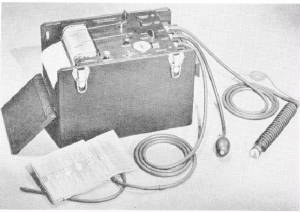
Cardio-Pneumo Polygraph
|
| Stoelting Cardio-Pneumo Polygraph |
This instrument was manufactured in the early 1950's. It was a self
contained, portable instrument, weighing approximately 25 pounds. It was designed to record accurately blood pressures and
respiration on a six inch graph which moved at a standard rate of speed. The pens were made of stainless steel, which made
them practically a fool-proof recording pen because they were non-corrosive. The motor operated directly on 120 volt, 60 cycle
current. The instrument was very sensitive and it's rugged construction offered many years of continued service.
This instrument is not in the Polygraph Museum's collection.
Stoelting's
First
Deceptograph
|
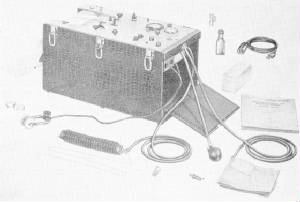
| Stoelting's First Deceptograph |
Manufactured in the early 1950's, this was the first of Stoelting's
"Deceptograph" line. It was a three channel instrument consisting of a pneumograph, a cardiograph, and a galvanometer. It
weighed 40 pounds and measured 22" long, 11" wide, and 14" high. It used jeweled bearings and precious metal divots for all
recording pens. Each pen was equipped with a counterweight to delicately balance the pen over the paper. The kymograph ran
a 6" or 12" per minute, selectable by the examiner. It ran on both 120 volt, 60 cycle current or batteries.
This instrument is not in the Polygraph's Museum collection.
Deceptograph
Stoelting Model #22500
|
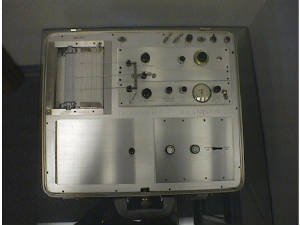
| Deceptograph |
Manufactured between 1955 and 1960, the Stoelting Model #22500
“Deceptograph” was the latest in polygraph design for it’s time. It featured three modules; one pneumographic
component, one cardiographic component, and a GSR component consisting of an amplifier and a galvanometer.
Another feature of this particular Deceptograph
is a concealed microphone. You will find it on the pneumo module on the far right. Under this fake knob are four
small holes to allow sound into the microphone concealed beneath the face plate on the instrument.
$300,
plus shipping and handling
Deceptograph
Stoelting Model #22500
|
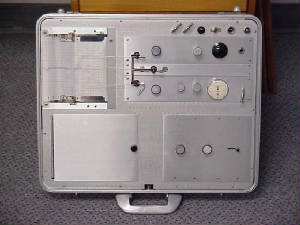
| Deceptograph |
Like the instrument above, it has three components: a cardiogaph,
a pneumograph, and a galvanometer. It has a three pen community inking system, and a six inch kymogaph.
Towards the bottom on the instrument
are two large doors. The one on the left is a storage cabinet for the GSR, pneumo, and cardio attachments, as well as ink
and other supplies. The compartment on the right is for the galvanometer. It is so large because the galvanometer was powered
by large vacumn tubes. This instrument was used before the age of transistors.
$300,
plus shipping and handling
Deceptograph
Stoelting
Model #22500
|
| Deceptograph |
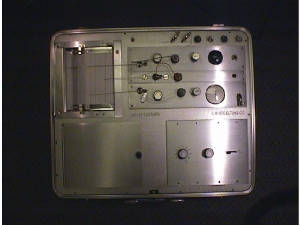
Like the two Model #22500's above, this Model #22500 had a galvanometer powered
by vacuum tubes, which required a thirty minute “warm-up” period before each test.
Weighing in at over forty pounds,
this instrument was remembered by all who used it a similar to carrying around a large rock. The bulk of it’s
weight came from the GSR unit.
This
particular instrument has been modified to accept a three bottle capillary inking system in addition to the community inking
system standard with this instrument. This modification was probably done by the examiner himself.
$300,
plus shipping and handling
The Truth Verifier
|
| The Truth Verifier |
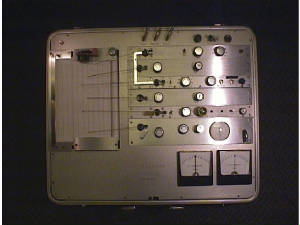
Affectionately known as the “Octopus,” this Stoelting
Truth Verifier was altered to include six channels. It was used primarily as a laboratory instrument by psychologists.
But it also used by polygraph examiners.
It is equipped with six separate recording modules utilizing
two separate three pen community inking systems. It gained it’s nickname when one polygraph examiner claimed that
you “had to have eight arms just to keep the pens centered.”
$300,
plus shipping and handling
The Bowling Ball
Stoelting Interrograph
|
| The Stoelting Interrograph |
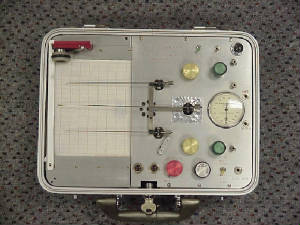
Touted as the smallest polygraph instrument ever made, this
three pen Stoelting instrument has everything it’s larger brother’s had. Affectionately called “the
Bowling Ball” by examiners due to it’s size and similarity to a bowling ball bag when carried.
Originally purchased in 1960 for $900 by Lincoln M. Zonn it was used between 1960 and 1985 when it was finally retired.
It was designed by Joe Hager, the owner of the Stoelting Instrument Company due to the demands by polygraph examiners for
a lighter instrument. It was discontinued because test subjects considered them “toys.” Less than 100 were
manufactured.
An instrument similar to this was used to test Jack Ruby regarding the murder of Lee Harvey Oswald following the
Kennedy assassination. The examiner was Phil Herndon of the FBI. He verified that Oswald was not part of a conspiracy
to assassinate the President.

$500,
plus shipping and handling
Cardio-Pneumo
Polygraph
|
| Cardio-Pneumo Polygraph |
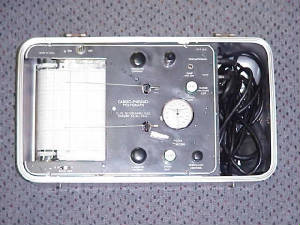
This two channel “cardio-pneumo polygraph” was introduced
by the C. H. Stoelting Company in the mid 1950's to compete with Keeler’s Model 6308 three pen polygraph instrument.
Nicknamed the “Tackle Box” by examiners due to it’s resemblance to a fishing tackle box when closed,
it was small and light to carry. This particular instrument was used by the McKesson-Robbins Drug Company in it’s
Hawaii offices.
$350,
plus shipping and handling
Stoelting
Model #: 22490X
|
| Stoelting Model #22490X |
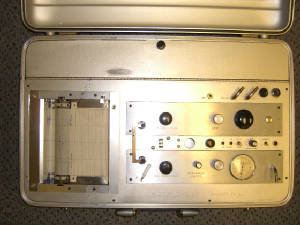
This instrument is a hybrid
between a Model #22500 and a Model #22600. It is equipped with one pneumograph and one cardio graph. It has a six inch kymograph.The
modules themselves appear to come from a Model #22500, but it encased in a Haliburton case similar to a Model# 22600. It is
a custom made instrument.

$300, plus shipping
and handling.
Early Stoelting Polygraph
|
| Custom Made Polygraph |
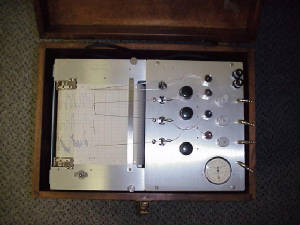
This instrument was hand made by C. H. Stoelting after his retirement.
Polygraph Examiners with specific requirements in instrumentation, contacted C. H. Stoelting after his retirement and requested
hand made instruments made to their specifications. This instrument is enclosed in a large mahogany case, with a utility
drawer in the lower portion to store attachments, ink, paper, and spare parts.
It contains two pneumographs, one
cardiograph, and a stimulus marker. The inking system consisted on four small open reservoirs. It is a one
of a kind instrument. It’s original owner is unknown.
$350,
plus shipping and handling
Emotional
Stress Monitor
Stoelting Model
#22600
|
| Stoelting Model #22600 |
The Stoelting Company pioneered many of the features that are
regarded as standard today --modular construction, friction chart drive, simplified inking systems and rugged, yet sensitive
recording sections.
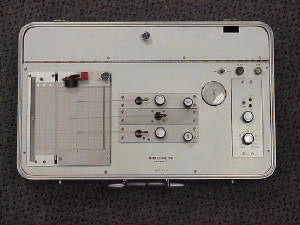
The Stoelting Model #22600 was a pioneer in polygraph instrument construction.
It contained three channels; a pneumograph, a cardiograph, and a galvanograph. Each was mounted in the face of the instrument
in modules which could be easier removed for repairs or replacement. These modules were housed in a metal case equipped with
a six inch kymograph, and community inking system.
$300, plus
shipping and handling
Emotional
Stress Monitor
Stoelting Model
#22608
|
| Stoelting Model #22608 |
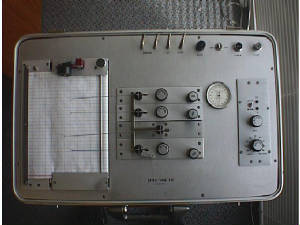
The Model #22608 was introduced in 1966. It was identical
to the Model #22600 with the exception of the second pneumographic module. It introduced a kymograph with eight inch
paper. A real improvement over the six inch paper before. This simple but rugged instrument soon became the favorite
of U.S. Government examiners.
This particular Stoelting 22608 was the primary instrument of
Terry R. Tanner. It has been equipped with ink loaded pens which allowed an examiner to use these older model instruments
well into the 1980's by replacing the need for the messy community inking systems.
$300, plus shipping and handling
Emotional
Stress Monitor
Stoelting Model
#22608
|
| Stoelting Model #22608 |
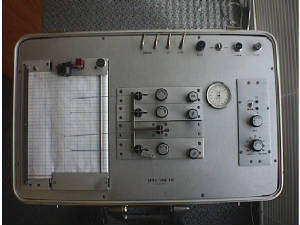
The Model #22608 was introduced in 1966. Notice the
red wheel on the left side of the instrument resting on the paper. This was the friction drive for the kymograph. It replaced
the older sprocket drive on the Model #22500.
It’s biggest customer was
the United States Armed Forces. This instrument, and other like it, were used by U.S. Army, Air Force, Marine and Navy
polygraph examiners as their primary polygraph instrument for many years to come.
Donated by Randall Aragon, Polygraph Examiner
 $300, plus shipping and handling
Emotional Stress Monitor
Stoelting
Model #22608
|
| Stoelting Model #22608 |
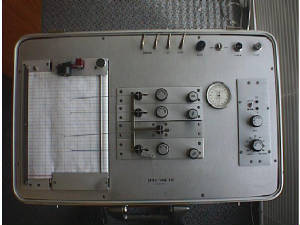
The Model #22608 was introduced in 1966. It was identical
to the Model #22600 with the exception of the second pneumographic module. Previous instruments contained vacuum tubes which
required a thirty minute “warm-up” period. It also introduced a kymograph with eight inch paper. A real improvement
over the six inch paper before. This simple but rugged instrument soon became the favorite of U.S. Government examiners.
This particular Stoelting Model #22608 was the primary instrument of Dewey D. Gillespie. Purchased shortly
after his retirement from the Seattle Police Department in 1976, he used the instrument on a daily basis until his retirement
from private practice in 1987.
Donated by Dewey D. Gillespie, Seattle Police Department
$300, plus shipping and handling
Emotional Stress Monitor
Stoelting
Model #22645
|
| Stoelting Model #22645 |
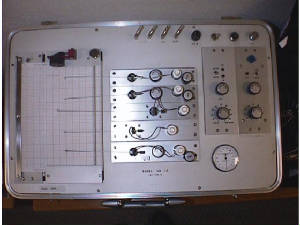
This model “Emotional Stress Monitor Polygraph”
consists of an individual inking system, two pneumographic modules, a Cardiographic module, a GSR module, and an additional
electronically enhanced fifth module.
This fifth module is second from the bottom and is user selectable
for either a CAM system or a second Cardio channel. Centering and Sensitivity adjustments are made on the insert next to the
GSR sensitivity plate.
Donated by the Family
of Denny Fox, Polygraph Examiner.
$300, plus shipping and handling
Stoelting
Multigraph
|
| Stoelting Multigraph |
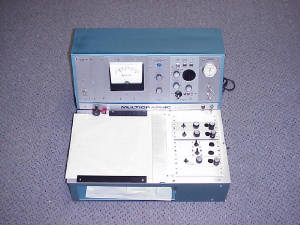
In the early 1950's, there was a trend in the polygraph industry
to move the polygraph instrument into the laboratory. Examiners began to wear white lab coats.
The Multigraph was created to meet the needs of these examiners.
A large desk top model, consisting of two pneumographs, a galvanometer, and two cardiographs, it looked like a piece of laboratory
equipment. It quicky fell out of favor in the polygraph community due to it’s lack of mobility.
Donated by Ron Decker, Polygraph Examiner
$400, plus shipping and handling
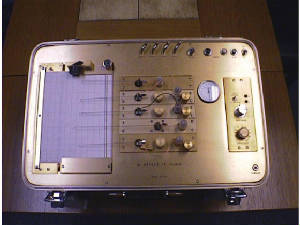
Arther IV Polygraph
|
| The Arthur IV |
The Arther IV Polygraph was the fourth model built for Dick
Arther by various manufacturers for sale. Built between 1972 and 1982, it featured five channels; two pneumographs,
one cardiograph, one galvanograph, and the fifth channel which was an event marker.
Dick Arther asked that the event
marker be added to his instruments after seeing one on a Berkeley Psychograph. The event marker is the channel at the
top of the module console.
Donated by Terry J. Ball, Polygraph Examiner.
$350, plus shipping and handling
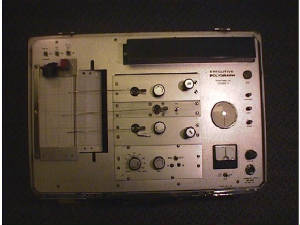
Executive
Polygraph
Stoelting Model #22532
|
| Executive Polygraph |
A three pen portable polygraph instrument. It was manufactured
between 1965 and 1970. It’s uniqueness lies in the fact that it will run on re-chargeable batteries. With
it’s built in battery charger, battery power meter, and it’s Samsonite Attache Case, it allowed the traveling
polygraph examiner to truly take his instrument anywhere.
It was a favorite instrument for
testing gold miners and diamond mine workers as it could be taken right into the mine.
Donated by Randall Aragon,
Polygraph Examiner
$300, plus shipping and handling
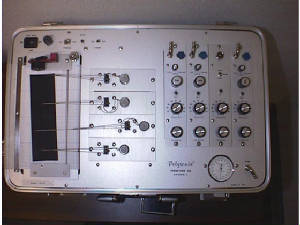
Polyscribe
Stoelting
Model #22770
|
| Polyscribe |
Introduced in 1974 and discontinued in 1979, the “Polyscribe”
was touted as the “Ultimate Polygraph.” It featured dual functionality by each of four modules that were capable
of handling both pneumographic or electrical inputs. Before this innovation of selectable functions, each module in
a polygraph instrument had a specific purpose.
The GSR system incorporated “Solid State” components which allowed more circuitry below the circuit board
to enhance the GSR functionality.
Donated by Janet Lehman.
$350, plus shipping and handling
Stoelting UltraScribe
|
| 4 Channel UltraScribe |
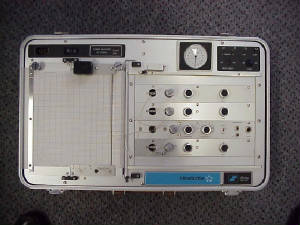
Introduced in 1979, the “Ultrascribe” is still Stoelting’s
top of the line analog polygraph. The original Ultrascribe was a four channel, all manual instrument as depicted here.
It allows the maximum in flexibility for the modern polygraph examiner.
This instrument had two pneumographs, a galvanometer, and one cardiograph. This is an all mechanical instrument.
Donated by Alan Stein, Polygraph Examiner.
$350, plus shipping and handling
UltraScribe
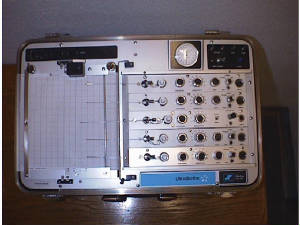
Stoelting Model #80500
|
| 5 Channel UltraScribe |
Introduced in 1979, the “Ultrascribe” is still Stoelting’s
top of the line analog polygraph. The second edition of the Ultrascibe was electronically enhanced. it allows the maximum
in flexibility for the modern polygraph examiner. It can handle up to five separate, selectable modules, including a CAM function,
movement sensor function, and stimulus marker function.
This instrument is still the top of the line in analog polygraph instruments offered by the Stoelting Company. It
is an all electronic instrument.
Donated by the Family of Robert P. Cosgrove, Polygraph Examiner.
$350, pus shipping and handling
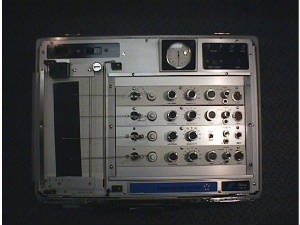
Executive UltraScribe
Stoleting Model #81500
|
| Executive UltraScribe |
The same polygraph instrument as the Ultrascribe above, except
housed in a small briefcase for the polygraph examiner “on-the-go.” It can handle up to five separate, selectable
modules, including a CAM function, movement sensor function, and stimulus marker function.
This particular instrument is equipped
with a “GSR Meter.” This meter was to be used during interrogations to alert the interrogator to a subject’s
concern about an issue. The meter, consisting of a small blue light bulb, plugged into the GSR RCA jack. As the
subject's galvanic response changed, the bulb would glow brighter or dimmer. It was thought that this meter would help improve
the quality of the control and relevant questions.
Donated by the Family of Robert P. Cosgrove, Polygraph Examiner.
